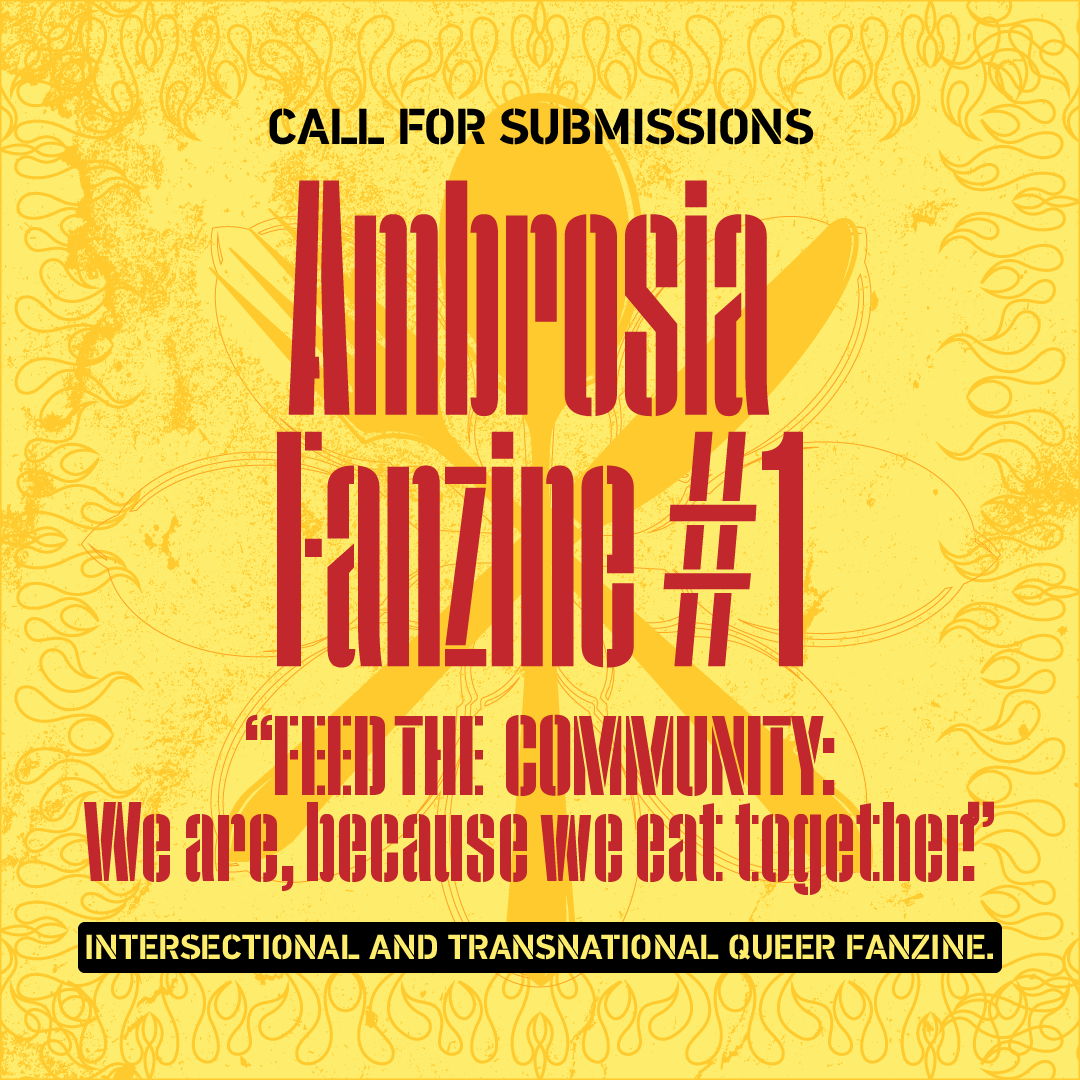
Call for Submissions! Reach Out If You're Interested!
Call for Submissions! Reach Out If You're Interested!



AMBROSIA
A Transnational Queer Food Fanzine
Ambrosia is an intersectional, transnational queer fanzine devoted to the study and celebration of queer food practices. It is a space for stories, recipes, manifestos, memory-work, visual art, and cultural analysis that document how queer communities build knowledge, survival, pleasure, and critique through food.
This is not simply a recipe collection.
It is an archive.
Queer food practices have long existed at the margins of both academic food studies and mainstream culinary culture. They live in potlucks, chosen-family dinners, underground supper clubs, mutual aid kitchens, breakroom microwaves, diaspora kitchens, bars, protests, and backyard grills. They are often undocumented, under-theorized, and unarchived.
Ambrosia exists to change that.
Why a Queer Food Fanzine?
Academic publishing moves slowly.
Cookbooks smooth rough edges.
Mainstream food media privileges marketability over memory.
A fanzine operates differently.
Zines have historically functioned as counterpublic infrastructure—small-circulation media that allow communities to produce knowledge outside institutional gatekeeping. They are tactile, imperfect, intimate, and resistant to polish. That form matters.
Ambrosia embraces the zine tradition because queer food knowledge often resists formal academic containers. Some stories about food and queerness cannot survive peer review. Some recipes carry grief. Some kitchens carry rage. Some meals are political interventions.
This zine creates a space for those forms.
What We Mean by “Queer Food Practices”
We use “queer” expansively and intersectionally. We are interested in work that engages:
Food as chosen-family infrastructure
Recipes as archives of migration, race, and survival
Queer bar food, street food, and informal economies
Trans and nonbinary embodiment in kitchens
HIV/AIDS, care, and communal cooking
Food as protest and mutual aid
Culinary disidentifications with tradition
Working-class and diasporic queer food worlds
Pleasure, excess, refusal, ritual
If food has structured your queer life in any way, we want to hear about it.
What We’re Looking For
We are currently seeking multi-genre submissions, including:
Personal essays
Critical reflections
Hybrid academic/creative work
Recipes with narrative framing
Manifestos
Visual art and collage
Photography
Comics
Short-form ethnographic snapshots
Experimental formats
We are especially interested in work that:
Interrogates race, class, gender, and colonialism in food cultures
Complicates nostalgia
Resists respectability politics
Thinks transnationally
Expands what queer food studies can be
Ambrosia is not apolitical. Food is never apolitical.
Language & Transnational Vision
Submissions are currently accepted in English and Spanish.
We are actively seeking collaborators in French and Portuguese in order to bring more of the hemisphere into conversation. Our long-term vision is hemispheric and transnational. Queer food practices do not stop at borders; neither should the archive.
If you are interested in collaborating as a translator or language editor, please reach out.
What This Is and Isn’t
Ambrosia is:
A counter-archive
A publishing experiment
A collective intervention in food studies
A site of queer epistemology
Ambrosia is not:
A glossy lifestyle magazine
A sanitized cookbook
A purely nostalgic project
We are interested in stories that feel lived, complicated, and materially grounded.
Call for Submissions
Do you want to contribute to an intersectional, transnational queer fanzine devoted to queer food practices?
We would love to hear from you.
If you have an idea—even if it feels unconventional—there is very likely a place for it here. Send us a short pitch (3–5 sentences) describing your idea, the form it might take, and any relevant context.
We welcome both emerging and established contributors.
Food has always built queer worlds.
Let’s document them—on our own terms.